

How a 25-person fintech backed by a16z is using autonomous AI agents as colleagues, not copilots, to scale a network of millions of physical merchants across the global south.
by Obie Fernandez, CTO

Late last year my article about working with Claude Code as a CTO went viral. People were fascinated by the productivity angle, but that wasn't what excited me. It was the glimpse of something bigger: AI that doesn't just help you work faster, but AI that works alongside you as a peer.
Over Christmas, I scrambled to build Nexus, our organizational knowledge graph, because every day without it meant losing context that would be impossible to reconstruct later.
Decisions, rationale, learnings, all evaporating. That urgency came from a conviction I've been developing since my time at Shopify applying AI to developer experience, and two years before that building AI-powered artificial employees at my previous startup called Olympia. More than ever I believe the future of organizations isn't humans using AI tools. It's humans and AI agents working together as colleagues.
At ZAR, we're not theorizing about that future. We're operating in it. We have autonomous agents defined by their goals and left to figure out how to accomplish them. They show up in our team chat, have conversations, request approvals when needed, and work 24/7. They are constantly learning and building on those learnings. This isn't a research project. It's production software, and it's changing how we build the company.
Why AI Teammates, Not Just More People
ZAR has plenty of funding. We could hire aggressively. We just don't want to.
Large teams create massive communications overhead and make alignment exponentially harder. Anyone who's worked in a 200-person engineering org knows this: most of the energy goes into coordination, not creation. Meetings about meetings. Alignment sessions. Status updates. Process to manage process.
AI teammates don't have this problem. They don't need to be aligned with company culture through offsites. They don't have competing career incentives. They don't misunderstand instructions because they were distracted in a meeting. They execute their goal with full access to organizational context, and they do it continuously.
Agents can make mistakes. They need well-defined goals to be effective. Their judgment, while improving rapidly with every model generation, isn't yet at human level for ambiguous or politically sensitive decisions. It may never reach that level. But for well-scoped, clearly defined work? They're not just cheaper than humans. They're better. They never context-switch. They never forget. They never deprioritize unglamorous but important work because something shinier came along.
Our thesis is simple: a small team of exceptional people, augmented by a fleet of autonomous agents, will outperform a large traditional organization. Not by a little. By a lot.
And this isn't limited to engineering. Everyone at ZAR, from engineering to design to ops, works in Claude Code and authors agents to help them with their work. This is how we scale without scaling headcount. It's the foundation for how our company grows.
What We Built
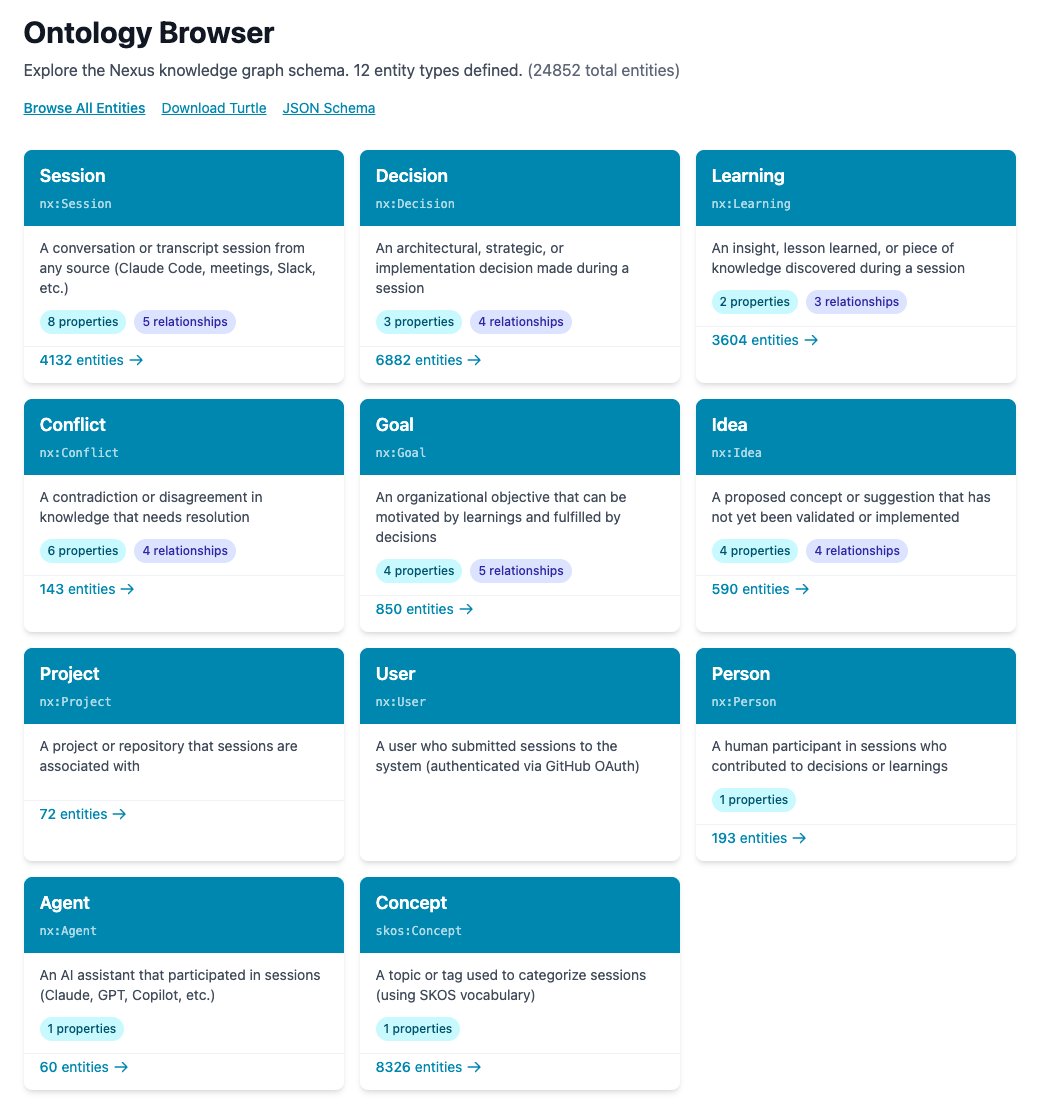
We built three systems that work together as a platform for high-agency autonomous agents:
Nexus is the organizational knowledge graph. Every coding session, every Slack conversation, every meeting, every GitHub PR: Nexus ingests these sources and distills decisions, learnings, goals, and ideas into a queryable semantic graph. When an agent or a person asks "why did we choose this authentication approach?" or "have we seen this error before?", Nexus has the answer with full provenance, including who decided, when, and why. Agents query Nexus constantly, which means they operate with full understanding of our organization at all times.
Agora is the orchestration app within the Agentus platform. It manages agent lifecycles: creation, scheduling, execution, monitoring, and communication. Agents can be triggered by cron schedules, webhooks from external services, or chat mentions. Each agent runs in an isolated container with its own persistent workspace, maintaining state and institutional knowledge across runs.
Agentus is the platform that ties it together. It's the foundation for treating agents as first-class participants in the organization. Agents get identities (we generate Roman-style names from their goals; our knowledge curator is named "Flavia Vigilans"). They get communication channels. They get budgets. They get evaluated on whether their output is actually used.
These aren't chatbots. They're capable workers with goals, persistence, judgment, and the ability to ask for help when they're stuck.
How It Works in Practice
An agent in our system is defined by its goal. It has a persistent workspace, access to MCP and CLI tools, and the ability to communicate with humans through team chat. It can act with shared credentials or on behalf of its creator. When triggered, the agent does its work, and the results show up as messages in chat, PRs on GitHub, or updates in whatever system the agent has access to.
These agents are autonomous by default. They don't need hand-holding. They can request human input when they genuinely need it, but the expectation is that they operate independently: capable workers with narrow, achievable goals that perfectly complement our senior people.
Example: The Code Janitor
Every engineering team has technical debt that never gets prioritized. Feature flags that should have been cleaned up weeks ago. Dead code. Stale dependencies. The kind of work everyone agrees matters but nobody wants to spend their time on, so it accumulates.
We built an agent whose purpose is keeping the codebase clean. It starts with a narrow goal: ensure no feature flags in our main repository are older than two weeks. It wakes up daily, scans for stale flags, researches context about why each flag was introduced (checking git history, querying Nexus for decisions, searching Slack for discussions) and then creates PRs to remove them. If it has questions, it pings the relevant person in chat. Otherwise, it just does the work.
The agent doesn't file tickets for humans to deal with later. It does the work. It creates the PR. Another set of agents can review it. Humans only get involved if something genuinely needs their judgment.
Because the agent has an identity and a persistent workspace, it's not locked into feature flags forever. As it proves itself, its scope expands naturally. Unused imports. Dead methods. Outdated configuration. It evolves into a code janitor responsible for all the low-hanging technical debt that engineering teams universally ignore because it never ranks high enough on the priority list. The agent doesn't have a priority list. It just has its goal, and it works toward it continuously.
Example: Production Errors That Fix Themselves
When a new error shows up in Sentry, traditionally someone has to look at it. Figure out what service it's in. Check git blame. Search Slack. Understand the context. Fix it. Get it reviewed. Sentry has added AI features to help with some of this process, but those features lack full organizational context.
Instead an error routing agent handles the triage process autonomously. A Sentry webhook fires, the agent wakes up, researches the error (git history, Nexus for prior incidents, Linear for related issues) and then fixes it. It creates a PR with the fix, which can be reviewed and merged by other agents. Humans only get pulled in when the agent genuinely can't find the answer in Nexus or elsewhere. Sometimes the entire pipeline from error to merged fix happens without a single human touching it.
Example: Scaling a Merchant Network Across Continents
The first two examples are about engineering. This one is about operations, growth, and creative work, because autonomous agents aren't just a developer tool.
ZAR's business depends on a global network of physical merchant locations where people can walk in and exchange local cash for digital dollars. We're building that network through a crowdsourced program we call the Ground Force: ambassadors who self-qualify and self-educate through the app, then earn rewards by going out and signing up merchants in their local area.
This creates a problem that would be nearly impossible to solve with traditional headcount. Enabling thousands of strangers across dozens of countries to walk into a shop and pitch ZAR to a busy merchant, effectively, requires getting the messaging right. What's the best opener to get a merchant's attention during a rush? What's the elevator pitch that conveys the value prop in 30 seconds? How does that pitch change from Karachi to Buenos Aires to Nairobi, where the local currency dynamics, merchant pain points, and cultural norms are completely different?
The traditional approach would be to hire country managers, commission market research, brief a creative agency, produce training materials, translate them, distribute them, wait for results, and repeat. That cycle takes months per market and costs a fortune. It doesn't scale to dozens of countries simultaneously.
Here's how agents change this.
We already produce AI-generated training content for ambassadors, localized by language and market. As we iterate on our scripts, what we're building toward is a system where agents handle the full loop: generating training videos with ZAR's branding, localized not just by language but by the cultural context and merchant pain points of each target country. An agent doesn't just translate a script from English to Urdu. It rewrites the pitch to lead with the problem that matters most to a shopkeeper in Lahore versus a kiosk owner in Nairobi versus a convenience store operator in Buenos Aires.
Different cohorts of new ambassadors get different versions. Agents monitor the downstream impact on onboarding KPIs across the entire acquisition funnel: how many merchants each cohort signs up, activation rates, first-transaction times, retention. When one pitch variant outperforms another, agents flag it, generate updated training, and push it to the next wave of ambassadors. The feedback loop that used to take months compresses into days.
This is the kind of work that would traditionally require a large growth team, a localization team, a creative production team, and a data analytics team, all coordinating across time zones. At ZAR, it's a small number of exceptional people defining strategy and goals, with agents executing the cycle continuously.
And it's not limited to ambassador training. The same approach applies to merchant onboarding flows, in-app education, support content, and marketing campaigns. Anywhere we need to produce, test, and iterate on content across markets at speed, agents close the loop between creation and measurement.
Distributed Consciousness
Each agent's persistent workspace (its instructions, state files, accumulated knowledge) represents a form of consciousness that can be versioned, forked, and merged. The "main" consciousness runs in the cloud, always on, handling scheduled work and chat interactions. When someone works closely with an agent on a complex task, the agent's context sometimes gets "forked" to run locally on their personal computer as a clone.
Learnings from the clone flow back to the main consciousness as pull requests, and it decides what to accept. Agents are the gatekeepers of their own evolution.
This happens passively and automatically. It's not a special workflow anyone has to learn. It's just how the system works. Agents get smarter over time, not just from model improvements, but from accumulated organizational context that compounds with every interaction. Noise filtering and self-correcting loops are built in, so the entire system's knowledge compounds instead of rotting.
Why This Matters
ZAR is building a product that gives people in emerging markets access to digital dollars through a self-custodial wallet and a global network of merchant locations. We're backed by Andreessen Horowitz, Dragonfly Capital, Coinbase Ventures, and VanEck Ventures. We have 25 people.
Twenty-five people scaling a physical network of millions of merchants across dozens of countries, producing localized content for every market, maintaining production software, and operating in a highly regulated industry. That only works if your organization is fundamentally different from the traditional model.
That's what we're building. Not a company that uses AI as a tool, but a company that's architected from the ground up around humans and agents working together. Every person at ZAR, regardless of their role, works with agents as part of their daily workflow. Engineers author agents that maintain code quality. Designers author agents that generate and test creative assets across markets. Ops people author agents that monitor obligations and surface what needs attention. The agents aren't a layer on top of the organization. They are the organization, alongside the humans who direct them.
We believe this is where all companies are headed. Most won't get there for years because reinventing how an organization works is nearly impossible at scale. You can't retrofit agent-native workflows onto a 2,000-person company with entrenched processes. You have to build it from the ground up with a small team that's willing to rethink everything.
That's exactly what we're doing.
Obie Fernandez is CTO at ZAR, a fintech company backed by Andreessen Horowitz, Dragonfly Capital, Coinbase Ventures and VanEck Ventures. Over his 30-year career in technology he has held positions ranging from Principal Engineer at Shopify to CTO at Andela, and authored notable books including "The Rails Way", "The Lean Enterprise", and most recently, "Patterns of Application Development Using AI."